|
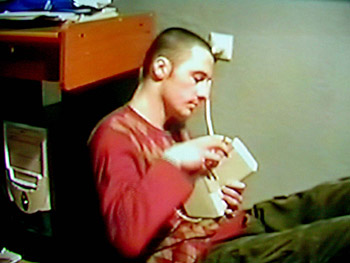
Three Virgins, 2003, DVD, 27 min |
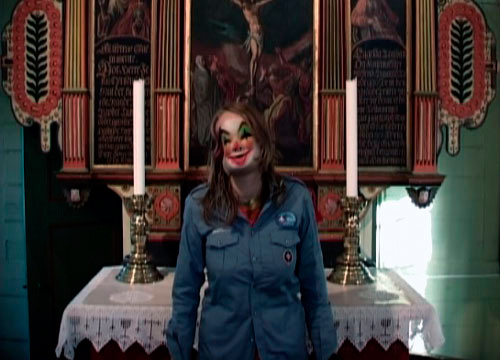
Happy, sexton, 2005, DVD, 3:42 min |
|
Don't Tell Anybody
The young artist puts forward a question: "Maybe I am late,
because everything has been said and done". A bothersome and
discouraging question one might say, especially in countries
which are "late" themselves. Quite astonishingly, this delay
inspires Jakup Ferri to produce his tongue-in-cheek comments:
We are late, so what? F. Bacon once said that by standing on
the shoulders of a giant, the dwarf can see much further. If
we unfortunately are the dwarves to our predecessors, we still
have the right to be whatever we are, or the right to, at
least, ridicule one another, don't we?
In the video titled Three Virgins, the artist first listens to
a performance by Yoko Ono and John Lennon calling each other
by their names, and then starts calling his own name "Jakup!
Jakup!" He might be resurrecting the old saying "Nomen est
omen"? Or, better yet, he might be searching for the place
where the"delayed" stand among the stars?
In the video Don't tell to anybody, Ferri counts the number of
grains in one kilo of rice. In medieval times, scholars
engaged in heated arguments over the number of angels
balancing on the point of a needle. For no purpose. Scholars
of modern day materialism count the number of grains in rice.
For no purpose.
Ferri finds a way to manifest this dream. He decides to
produce toilet paper with Koons's name on it. With his arse,
this young artist pokes fun at reality as he sees it: Kosova
that produces almost nothing, the distress of the delayed
artists, spiritual jam and stopover of Western art, Koons4
ability to mock and soak the rich.
Shkklzen Maliqi |
Artist’s statement
I am interested in themes that explore the private and
domestic dramas, especially of those the ‘room’ hold
secret. Rooms are, as in the physical or physiological
definition; stages or sets for drama and personal stories.
A ‘room’ may hold little, but significant information
about stories and the lives that have been occupying them or
presently occupy them. I see the use of the ‘room’
within my work as a frame for drama and stimulation for
performative montage. In my work, I often explore themes that
are linked to the ‘room’ issues dealing with suicide
and psychological breakdown, sex and violence, nostalgia,
stereotypes and the effects of religion and tragic events - a
state of mind and a state of place. Much of the inspiration
comes from film-noir and contemporary horror as well as world
events that affect the private person; civilian, in one
way or another.
The work ‘HAPPY, sexton’ (Video, 2005, 3 minutes 17s)
was created entirely within the confined space of a Lutheran
Church in Norway with the use of a small selection of props; a
boy’s scout shirt and a 70’s clown mask. Whilst being circled
within the ‘holy alter’ with these props; the performance had
no start, no ending and no script-
‘I am the loudest woman in the world-
I am so happy!
I am happy all the day, and the next day
And the next day
And the next day
And the next day
-I am happy
-I am happy
My name is Happy!’ |