
BOO RITSON
The
Hobo and Friends
March 21 – May 02, 2009
Opening Friday, March 20, 7 pm
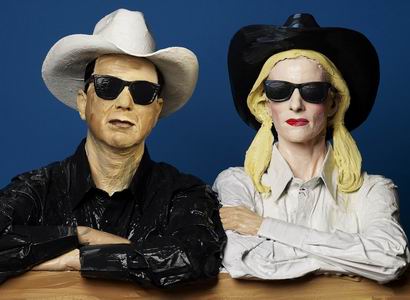
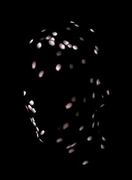
After covering her models which mostly derive from her personal circle of friends and acquaintances with protecting cream, Ritson rapidly coats their faces, hair and clothes with impasto paint. The colourful make-up that the artist uses to transform the look of her living models into something artificial doesn’t serve the idea of making them more beautiful or of creating persons without blemish. The primary function of Ritson’s mascerade is to create personalities that give up their original identity. By evolving her illusionistic portraits and transforming persons Ritson in many cases draws on characters that she has developed in stories written by herself.
The artist’s figures mostly are stereotypes of Hollywood and the American culture.
Among the seven art works shown in the exhibition “The Hobo and Friends” for example there are a portrait of a hobo, one of a cowgirl and a cowboy as well as stylized images of synchronised swimmers, all of them in front of a mostly dark blue, monochrome background. For the purpose of their attributes the portraits are a direct allusion to the American way of life.
The peculiarity of Ritson’s art works is covering up the eyes of the persons shown by big black sunglasses, which helps the artist to minimize the liveliness of her figures. The coverup intenses the irreal character of the persons shown so they become statues. The effect of illusion furthermore is being derived by photographing the threedimensional works. As the wet colour is still shining on her models’ skin Ritson’s illusionistic artificial entities are being photographed and therefore frozen for the eternal moment.
In the process of transforming a person into another the artist synthesizes several different artistic means. In Ritson`s portraits photography, painting, sculpturing and performing are becoming one singular unit which is making the works extravagant. Due to her eclectical methods Ritson’s art works are stylistically difficult to classify. Though the process of work itself is expressionistic, the artificial final product is following the idealistic idea of pop art. Ritsons portraits, mostly sized 120 cm by 100 cm, remind in many ways of the works by famous pop artists. In Ritson’s works, the viewer will find Claes Oldenburg’s technique of alienation of everyday objects and Andy Warhol’s serial portraits. She also is inspired by Chuck Close’s works orientated on the indirect reality of photography as well as by the superrealistic works of Duane Hanson.
Creating her surrealistic portraits Ritson is using an outstanding eclectical method through which the artist has not only found her own style, but also managed to give reality a new face and to unfold realness behind the illusion through alienation.
Thorsten Brinkmann | Boo Ritson
| Clarina Bezzola | Hannu
Karjalainen
WHO ARE YOU?
Faceless Tableaux Vivants
New portraits in photography and video art
Group Exhibition
June 26 to August 16, 2008
Opening Thursday, June 26, 2008, 6 -9 pm
Galerie Adler New York
Galerie Adler New York is pleased to
announce "Who are you? – Faceless Tableaux Vivants" featuring the four
young international artists Thorsten Brinkmann, Boo Ritson, Clarina
Bezzola and Hannu Karjalainen.
Emerging in early 19th century, the "tableaux vivants" originally were
re-enactments of famous pieces of art by actors or models for the
instruction and entertainment of the upper class society. In their own
way, each of the artists develops this concept further, playing with the
idea of "living pictures" and "staged portrait photography", starting
out from central themes of paintings and sculptures but translating them
in photography, video and performance.
The common theme they work on is the portrait which classically is to
display the likeness, status, personality, or even the mood of the
person depicted. But what if the portrayed persons do not show their
faces, or when they hide their sentiments covered by painted masks,
running colour, textile fibre sculptures or all kinds of everyday-life
and furniture objects?
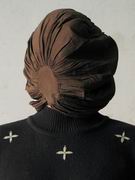
Thorsten Brinkmann's (*1971 Stuttgart, Germany) photographic
self-portraits turn this classic genre upside down. His work is
initiated by objects discarded by civilization, ordinary things like
bottles, flower pots, lamp shades or shelves. The results are strikingly
picturesque and unconventional at the same time: dimmed colours with
soft contours reminiscent of the classical three-quarters portrait have
us reassess our viewing habits. The visual object is covered, hidden,
and slightly deviates from the context we are used to, drawing us into a
picture-puzzle between photography and painting.
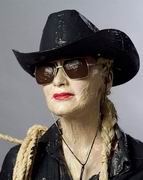
A pair of bloodshot eyes peers blearily from what appears to be a
painted bust, but there is an unmistakable glint of something living,
and this is no straight-forward portrait. Boo Ritson (*1969
Surrey, UK) covers her models' faces and bodies with barrier cream and
household paint, following their outline, hair and clothing. Rather than
having her subjects impersonate a pre-existent concept, she draws from
pure American pop stereotypes and turns her subjects into scurrile
versions of their own self.
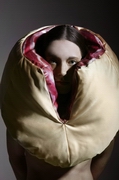
Transformation is the word that comes to mind with the works of
Clarina Bezzola (*1970 Zurich, Switzerland). Coming from a soprano
career at the opera, she has a strong connection to stage scenes and
theatrical dramaturgy. Her characters become living sculptures, seem to
tell us a story about metamorphoses, as we watch them in the process of
transforming into fences, mattresses, or billowing mega-corps without
any clear shapes. With their faces often hidden, her protagonists'
expressions are only partly visible and her performances focus on
gestures captured during strongly expressive movements.
The protagonists of Hannu Karjalainen's (*1978 Haapavesi, Finland)
video works are lonely, enigmatic, seemingly soulless creatures. "Man in
a blue Shirt" builds a tension between the indexical traits of the image
and the painterly gestures animating and transforming its surface when
the weathered skin becomes replaced by the gloss of the pouring paint.
In an uncanny way, Karjalainen's work enacts what Roland Barthes
described in photography, when he noted that the photographic image was
a "living image of a dead thing", incapable of differentiating between
the dead and the living - animating them equally, making them equally
real.
Hanauer Landstraße 134, 60314 Frankfurt, Germany, +49 (0)69-43053962
mail@galerieadler.com, www.galerieadler.com