
LÉOPOLD & TILL RABUS
Entre différence et complicité
January
24 to March 7, 2009
Opening Friday, January 23, 6 PM
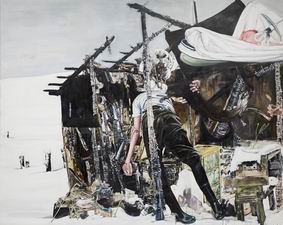
Motives belonging to black romanticism traverse through Leopold Rabus’s entire work. His works irritate in many aspects for his fascinating subject matter, which appears to come from another world and is segregated into numerous perspectives, is juxtaposed by a precise painting technique akin to that of a virtuoso. Like in phantasmagoric dreams, grotesque characters appear as if frozen in irrational positions. Yet it is exactly these exaltedly morbid deformities, which open an almost impressionistic passage towards reality for Léopold Rabus. After all, the cradle of his illustrations is often to be found in his immediate past, whereby the recollection of these very events, exercised in a romantically melancholic manner, is blurred and has faded over time. Ostensively inspiring for Léopold Rabus is the everyday, marked by its banal moments and ordinary places. The rural idyll, however, is contaminated due to Léopold Rabus’s adoption of a dream as a medium for the illustration of these very unwanted memories. Léopold Rabus doesn’t intend on creating a shocking setting, but nevertheless, his characters from the animal kingdom and human society seem dismal and morbid. The excessive composition of deformation and grimaces often grants the works certain humorous elements. Paradoxically, a decadently aesthetic from of attraction additionally emerges from these characters and the observer thereby finds himself taking on the role of a voyeur, observing the somewhat spine-tingling occurrence or the portraits of seemingly demon-like animals, as if compelled to. In addition to the antique framing of the animal portraits, the pictorial tradition of landscape and genre painting helps in terms of distraction. To a certain extent, Léopold Rabus pursues this tradition, integrating analogous elements in his paintings.
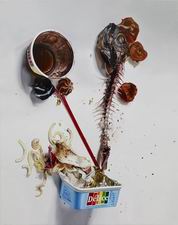
What brother Léopold tries to achieve through landscape and genre painting is pursued by Till Rabus with reference to the tradition of the Vanitas in still life painting. His arrangements of food scraps and packaging materials seem grotesquely horrifying, yet nonetheless, your focus tends to remain fixed due to the work’s technical brilliance. From a technical point of view, the works, arranged as a series, refer to hyper-realism and to American photorealism of the 1960’s. Associations to pop art can be drawn through the illustration of everyday objects. Till Rabus establishes ties to the pictorial tradition of old master painting and its iconography, resorting to a form of radical realism. However a quasi half-aerated veil invariably lies over his works, allowing us to get a slight glimpse of today’s cold brutality.
Henceforth, black romanticism is categorically common to both oeuvres. They address loss, the past, and the ephemeral, and glance shrouded at our conception of reality.
Hanauer Landstraße 134, 60314 Frankfurt, Germany, +49 (0)69-43053962
mail@galerieadler.com, www.galerieadler.com