
Self Organizing Still Life
(SOS)
Sound stimulated interactive Sculptures
The Acronym SOS implies communication within the trust of an interdependent
social system. Fried has chosen SOS - Self Organizing Still Life, as the
working title for his ongoing series of sound-stimulated interactive
sculptures, which premiered at Art Berlin in 1998. Since then, his SOS
sculptures have been in numerous solo and group exhibitions, including a
touring museum show including works by Rebecca Horn, Robert Rauschenberg,
Leo Erb, Günter Uecker.
Whatever the scale or materials used for the SOS, all of these works consist
of solid spheres, which are stirred into motion by ambient sound on a
predetermined level object. Audible sound is transformed live into waves
that silently stimulate each of the spheres into motion. The resulting
action of the individual spheres and their interactions with one another are
undetermined. They rearrange themselves in continually new patterns of
elegantly fluid choreography.Some kiss, some spin off alone, while others
race head-on only to meet with a soft embrace, or swerve around one another,
often changing the path and destiny of each other without physical contact,
as each sphere is able to feel one another.
Fried is able to give an individual character to each of the solid hand-made
spheres, allowing them to respond and behave differently to live sound,
though the artist is able to give each entire SOS a particular overall
tendency of choreographic response. Like two people would dance differently
to the same music, the spheres interact in a unique and live choreography
directly initiated by its environment. When an acoustic signal is no longer
detected, the spheres come to rest in ever-different constellations (Still-Life).
As we simultaneously influence and trace the movements of the spheres, our
attention becomes increasingly focused on the non-linear dynamic
relationships that unfold between them, effectively shifting the emphasis
away from the individual objects themselves towards a highly subjective
glimpse of the bigger picture.
Creating a complex live visual experience, Fried‘s interactive sculptures
are compelling by their symbolically provocative simplicity, as the viewer
is moved to forge perspectives on relationships, life and the universe of
thought

'Kunst in Bewegung', Exhibition Museum Würzburg |
In bed with Lucy and Dolly
Photograms
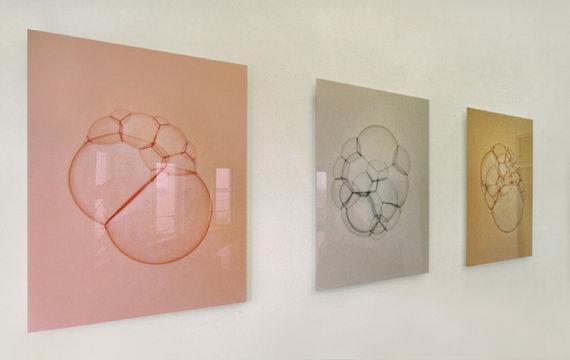
Mapping the temporal balance between water and air
in the form of unique bubbles - which emerge as a result of dynamic systems
that do not follow linear and hierarchal patterns of organizational behavior
- Fried charts the fundamental economy of networks in nature. In varying
chromatic tones, Fried depicts strictly non-biological membranes that evoke
a strong resemblance to primordial living cells or biotech test-tube
creations, and remind us of just how strong yet corruptible the architecture
of life is.
Fried creates large gaseous vesicles in a totally darkened room using
infrared goggles and, at the decisive moment, photograms them onto grainless
color sheet-film. Specifically, he uses the shadows of objects - even
transparent things - to make an image on a photosensitive support using only
light and the light sensitive material. No camera, no lens. What we see in
his enlarged C-prints are the latent shadows and spectral aberrations of
these transparent forms.
The title refers to Lucy (the early hominid Mother), to us (the Myth), and
to Dolly-the-Sheep (the Missing Link) in a dialogue that seeks orientation
in a world in which man has moved from controlling the environment to the
inescapable urge to invent our predecessors. Fried takes us on a biomorphic
journey from the Cambrian sea to the artificial womb.
Rainscapes
Photography
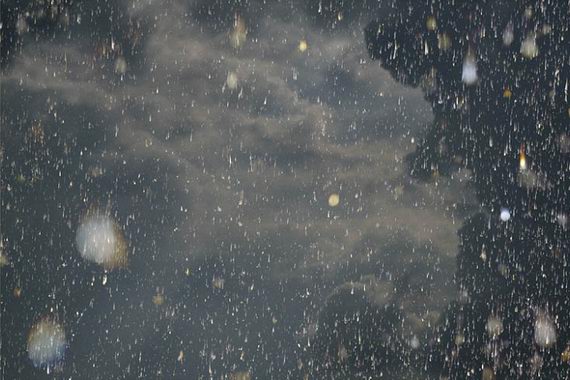
At first glance, the colorful arrays of countless water drops in Fried’s
Rainscape photographs appear to be falling galaxies - clusters of dripping
light painted on the night sky. On closer inspection one sees that they are
actually photographs of pure falling rain.
Fried captures strongly individual patterns of rainfall on large format
color film. Rich chromatic variations are revealed by the prismatic effect of
light passing through each individual raindrop, evoking a spacious cosmic
look. Fried’s large-scale Rainscape photographs exude a quiet replenishing
quality that unloads poetically within the viewer.
Observing what gives rise to civilizations, or may ultimately lead to their
demise, Fried sees freshwater as problematic in the 21st century. Since
ancient times, with prayer and rituals - to science and its methods, humans
have wished to influence the weather, and although the collective human
pursuit has undoubtedly had profound affects on the ecosystem, we are
luckily still unable to control bigger systems such as the weather. Rain
still falls freely through the world’s trees, and harvesting hands before
completing it’s cycle. However, access to - and usage of - clean water is
being moved into increasingly privatized hands, servicing industry more than
local needs and down river ecosystems. Fried’s Rainscapes portray sweet
water at its birth and invites us to contemplate its worth as we become its
temporary custodians
Hanauer Landstraße 134, 60314 Frankfurt, Germany, +49 (0)69-43053962
mail@galerieadler.com, www.galerieadler.com