
Klaus Wanker: Living in a Magazin
on beautiful surface and abysmal emptiness
Fashion is perfection for the moment. It is a promise of
uniqueness as well as of affiliation. You can’t abscond from fashion,
especially when you’re young. In the centre of fashion world stand the
models filling it with life, only few of them as famous as the clothes
they wear. Mar-keting and music have developed codes manipulating
teenagers’ formation of identity. Vien-nese artist Klaus Wanker takes this
street wear fashion world into his painterly focus. His art is not about
fashion itself, it’s about this manipulation conducted by industrial
marketing.
It is always the faces that dominate his pictures. They look the viewer
into the eye, turn side-ward, turn away or look right through you. Their
mimics strangely distant, his figures stand before blocks of colour,
circles and stripes, their bodies craned, heads arrogantly in their necks,
arms on hips. They are all young and beautiful in an immediate and
touching way, yet their algid aloofness is almost painful. Their faces do
not represent personality, not character; they are no portraits, but
painted surface. And still, they embody an urgent demand for vivid
individuality.
This contradiction stands for a young generation’s want for identity,
membership and a posi-tion in society. Pose and mimics serve but one goal:
visualizing an attitude to life. An attitude which is made accessible for
home use through the advertised product. Wanker’s templates come from
fashion magazines. The artist specifically decides for advertisements with
young and unknown models hoping for their breakthrough. He fulfils their
wish – just not in the way they had thought. Instead of being film or
fashion stars, they become the centre of a picture based on the same
strategies as advertising pictures. Wanker’s artistic strategy of exposing
a soulless commercial branch and its manipulating influence on youth
culture adds up: The models in their austere and algid beauty are all but
happy and strangely vulnerable. Wanker utilises the advertising and
fashion photography as substitute, as the only more or less le-gitimate
space for what has been banished from high arts: beauty.
In his transformation of consumer goods, Wanker focuses on an increasing
commercializa-tion of everyday life that teenagers have to come to grips
with. Wanker’s exposure to sym-bols and their social meaning are
interfaces to his central paintings of youthful models. In his painted
transference, Wanker inserts backgrounds with designs typical for
exchangeable spaces such as club rooms, metro stations or music videos. He
reduces the backgrounds to rudimentary geometrical forms presenting the
“star” as placed in front of a light box back drop. His choice of the
frames, the emphasis on the faces closely related to the close-ups often
applied in advertising photography stands in the same context
While his paintings where untitled in the beginning, he now adds script to
his latest works, that also form titles. The decisive factor therefore is
the advertisement’s slogans always com-ing with the pictures and sometimes
laid over the pictures in music clips and films. This pene-tration of
script and picture is visualised through the transparency of letters that
span over the whole painting, catching the eye only at second view.
Hollywood plays its role here, too. Especially in large and expensive
Hollywood productions, product placement is of increasing importance. It’s
this subconscious manipulation that Wanker wants to transpose into
painting. The script is comprised in the painting process, is put onto the
surface simultaneously with the figure. The paintings’ frugality rather
represents anti-advertisement, thereby contradicting its motive.
For his big “Swimming Pool” – pictures, Wanker emanates from photographs
showing water in a pool. He breaks up the undulation and decomposes it in
colour segments. In “Five Girls Under Water Fight”, a paperwork displayed
on the floor and seeming as if seen from bird‘s eye view, the colours
evoke connotations of people diving under the surface and through the
water’s movement melts into abstract forms of colour. In this works,
Wanker plays with fig-uration and abstraction, mainly focusing on this
theme’s aesthetic components. While in this “waterworks”, pure painting
already stands back behind the idea of presentation, Wanker emphasizes
another formal aspect in his following works: the size.
The centre of his ensemble is formed by four large-format paintings: On “flagship”,
a giant pink strawberry flies through the light blue colour field, while
on a different painting a panicle of grapes hovers over a bright green
underground. Blueberries spooking loosely through matter and all these
artificial, plastic-like fruits are accompanied by three small round
panels showing pink strawberries with differently coloured dots. This
works is fed from the discus-sion on genetically manipulated food. Wanker
transforms this theme into flatulent fruit paint-ings executed on
polystyrene. The artificial base seems like an ironic wink to manipulation
of nature. The fruits’ size forces them to the ground; they lie in line
there, to the strawberry’s sides – a bunch of grapes, a sunny side-up – as
if the worn monstrous aliments were starting on last effort to riot.
In BANG BANG, the viewer is literally surrounded by three wall size works.
Wanker expands two-dimensional painting into space: The pictures show
scenes from a video game, con-structing an illusionist space. Teenagers
live in their own worlds consisting no longer of two-dimensional pictures
but of an hermetic and fantastic reality. In a large-scale painting, three
young people are pointing their guns in different directions into the void
dominated by a heli-copter drawn onto the wall additionally increasing the
painterly illusion. Five coloured Styro-foam disks stand as abstract signs
for their shots. The paintings do not reveal the game’s dramaturgy. Wanker
does not provide a real setting of winners and losers. In contrast to many
artists analysing in their work the interface between fiction and reality
through anima-tion, Wanker paints “Action”. Painting has long since lost
or passed on this function to the new media. To repaint scenes of this
subject is to deal with its aesthetics and contents and adding something
to them through painting.
While in BANG BANG, the freedom a youthful generation’s alter ego is
assumed to posses can be relived in the installation of the painted video
game, Wanker simulates a different but no less artificial world in his
magazine allowing an escape from reality. For a short time, Wanker has his
models dive into their private worlds where each of them can indulge in a
short lived stardom. World-famous for 15 minutes, so Warhol’s prophecy for
everybody is more topical now than ever before. Almost it seems as if
being a star had become a brand mark to comprise whatever content one may
want to fill it with, best prove hereof being the everyday afternoon talk
shows.
Having worked as a model himself during his time in university, Wanker
soon found out that in reality, behind the glamour and magic of the beauty
business, those in the spotlights are mainly beat-up people. Beauty and
attractiveness are attributes one doesn’t speak about critically. One owns
these attributes in superior and tacit acceptance. The idea of beauty is
adjusted and regularised. Who or what appears to be beautiful for what
reasons, who de-cides and who defines what will be brand marked
“beautiful” in a certain time and place? Wanker paints models. These
paintings, he integrates into an imaginary fashion magazine titled
“Imaginary Stardom. Collection 03/04“.
Wanker’s Star Sketches stand for the Warholian disideologization and
dishierarchisation. Being a Star is before and above all free space for
individualism. Yet it lies in its nature to bring forth new group
phenomena subjected to specific codes and uniforms. The concept of Istar
and the high gloss magazine “Imaginary Stardom” are painted commentary on
this. As structural constituents of youth culture, outfit and lifestyle
combine to form a sort of happi-ness intending a feeling of “Imaginary
Stardom”. As in real fashion magazines, Wanker’s Collection 03/04 first of
all shows beautiful people in beautiful clothes. Wanker doesn’t leave it
at purely aesthetic adaptations: The fashion statements are based on
fashion codes, which Wanker transforms into seven large-scale bar codes,
the EAN-paintings.
Wanker subtly changes the emblems designating products of the everyday
world provided by society. Models’ set cards, listing mere formalities and
vital statistics - abstracted surface to signalise through feature
advantages a product’s saleability to the client - serve as basis for his
codes. The individual is reduced to pure data. Accordingly, the painterly
share is ex-tremely reduced, the loss of identity stressed through the
synthetic sealing. In the end, the beautiful surface remains an illusion
in which the passer-by form this entirely opposite world always seems to
hear the music play
Text: Peter H. Forster, 2005
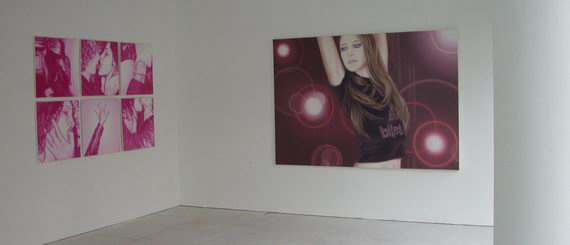
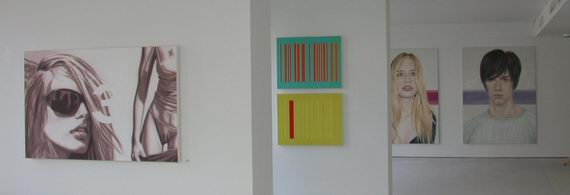
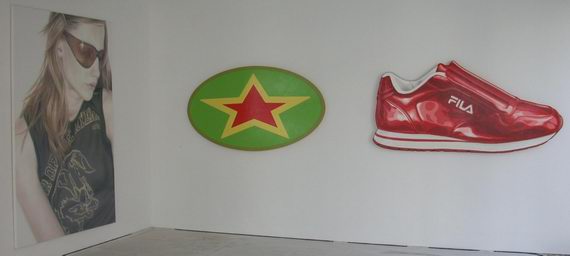
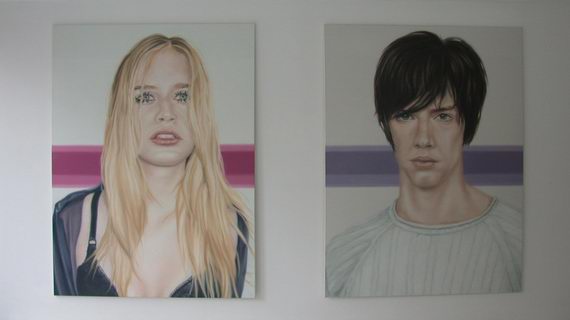
exhibition "imaginary stardom" 2003,
Reuterweg 18, Frankfurt
Hanauer Landstraße 134, 60314 Frankfurt, Germany, +49 (0)69-43053962
mail@galerieadler.com, www.galerieadler.com