Alejandro Vidal - Press release

"Demons
Dance Alone"
Video, photography
November 2nd - 25th, 2006
opening reception: Thursday, November 2nd, 6 to 9pm
Galerie Adler New York City
Galerie Adler is pleased to announce the New
York solo debut of spanish artist Alejandro Vidal.
Alejandro Vidal's (* 1972, Palma de Mallorca, Spain) recent video 'Tactical
Disorder' (2006) inquires into the relationship between the state of
security and the culture of fear. The increasing number of security measures
which are driving us to a "post-political" scenario ,thereby changing the
political register away from the State, from conventional concepts, and from
accepted identities, saying instead that politics emerges through lifestyle,
through Art and discourse. It's now impossible to differentiate between
technologies of control and regulation. Vidal highlights the lack of
communication and the limited political emancipation of our contemporaries.
Some of Alejandro Vidal’s previous videos begin as a point of inquiry into
the power of fear and the control it exerts over contemporary urban
societies. Vidal culls his symbols from street culture, punk music scenes,
performative death rituals, and popular film figures. While his work focuses
on common depictions of violence to which we as media consumers have become
desensitized, his interest lies in deconstructing these representations. His
videos highlight the performative aspects of violent acts coupled with the
power these performances have on our everyday attitudes and behaviors. He
examines the underlying consequences of what we absorb through the political,
social, and media messages we receive in the state of alarm in which we live
today.
Vidal’s work often presents the moments leading up to or the aftermath of a
scene of violence. What remains or hangs over such a moment is the anxiety
of the unknown, the anticipation of something terrible that allows our minds
to twist and create deeper fears than we need. Examining these reactions
within the confines of art allows us as viewers and as members of society to
apply that critical structure into our everyday thoughts and reactions.
Best regards
Ulrike Adler
|
|
"Deciphering Scars"
Video, photography, installation
April, 15th - June, 11th 2005
opening reception: Friday, April, 15th, 7 pm
Galerie Adler Frankfurt am Main
Frankfurt am Main, March 2005 – Social conflict, self-defence and violence
are the issues explored by Alejandro Vidal (*1972, Palma de Mallorca).
Gallery Adler, Frankfurt am Main, Germany, presents photographies, video
projections and an installation by the young Spanish artist in a solo
exhibition from April 15 to June 11, 2005.
With critical distance, Vidal investigates aesthetic positions prior to the
act of violence. He brings together influences and concepts from
video-manuals of self-defence to 80`s punk, early rave techno or 90’s cult
movies. He brings all these concepts together to organize them as an attempt
of understanding an historical moment and its implications. Vidal sees the
connections between radical politics, music movements like punk, rock or hip
hop and suicide. All them linked with the need of an audience and a staged
mise en scene.
Vidal investigates the social, political and economic implications of
contemporary Art taking a critical look at the way in which marketing and
politics distort our attitudes towards violence and life within our cities.
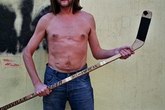
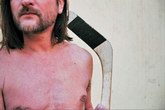
‘A thousand lonely Suicides’ is Alejandro Vidal latest series of work. The
photographs - shown in the exhibition - portray an ex-convict who after an
homicide attempt tried to commit suicide in front of the police, just before
being detained, using the ancient practice of hara-kiri.
Hara-kiri is nothing but a last performance ritual, in front of a selected
public. This selected public participates in the ritual; without it
hara-kiri wouldn’t exist, the action would just be a "killing yourself".
Politics, rock stars, etc… share this public dependence, they need to kill
themselves actually or metaphorically with the public as an active-passive
tool and as a part of the violence they execute.
Seppuku (切腹 from the kanji "cut" and "stomach") is a Japanese word that
means ritual suicide by disembowelment. Seppuku is better known in English
as hara-kiri (腹切り, literally "cutting the stomach", written with the same
kanji as seppuku but in reverse order), which is considered the more vulgar
term. Seppuku was a key part of bushido, the code of the samurai warriors;
it was used by warriors to avoid falling into enemy hands, and to attenuate
shame.
From the 1920’s & 1930’s the media started to reach mass audiences through
politics. We have met this idea before and we call it propaganda. Looking at
recent history we see how the media manipulated audiences for ideological
and political purposes.
The various slogans founded in the lyrics of early punk bands, to the
proliferation of bands in the early eighties, punk rock, like hip hop or
techno and electronic subcultures had a strong relationship with explicitly
anarchist and radical political content over the years. The experiences of
anger and exaltation that rock music provided for countless young people
were not in themselves political experiences, but rock could become a potent
political force when linked to real political organizing. Adorno was
convinced that music could be so powerful it could force individuals to
realize their existence.
Vidal takes a critical look at the way in which media and politics distort
our attitudes toward violence. Cautiously he explores „state security“ and
its terror codes. He talks about a "culture of fear"; the more awesome the
system is, the more society exploits fear, the more superficial our values
are becoming.
 |
|
 |
|
 |
|
A thousand lonely suicides, 2005 |
||||
Hanauer Landstraße 134, 60314 Frankfurt, Germany, +49 (0)69-43053962
mail@galerieadler.com, www.galerieadler.com