Alejandro Vidal - Pressemitteilung

"Demons
Dance Alone"
Video, photography
2. bis 25. November 2006
Eröffnung: Donnerstag, 2. November 2006, 18 bis 21 Uhr
Galerie Adler New York City
Galerie Adler is pleased to announce the New
York solo debut of spanish artist Alejandro Vidal.
Alejandro Vidal's (* 1972, Palma de Mallorca, Spain) recent video 'Tactical
Disorder' (2006) inquires into the relationship between the state of
security and the culture of fear. The increasing number of security measures
which are driving us to a "post-political" scenario ,thereby changing the
political register away from the State, from conventional concepts, and from
accepted identities, saying instead that politics emerges through lifestyle,
through Art and discourse. It's now impossible to differentiate between
technologies of control and regulation. Vidal highlights the lack of
communication and the limited political emancipation of our contemporaries.
Some of Alejandro Vidal’s previous videos begin as a point of inquiry into
the power of fear and the control it exerts over contemporary urban
societies. Vidal culls his symbols from street culture, punk music scenes,
performative death rituals, and popular film figures. While his work focuses
on common depictions of violence to which we as media consumers have become
desensitized, his interest lies in deconstructing these representations. His
videos highlight the performative aspects of violent acts coupled with the
power these performances have on our everyday attitudes and behaviors. He
examines the underlying consequences of what we absorb through the political,
social, and media messages we receive in the state of alarm in which we live
today.
Vidal’s work often presents the moments leading up to or the aftermath of a
scene of violence. What remains or hangs over such a moment is the anxiety
of the unknown, the anticipation of something terrible that allows our minds
to twist and create deeper fears than we need. Examining these reactions
within the confines of art allows us as viewers and as members of society to
apply that critical structure into our everyday thoughts and reactions.
Best regards
Ulrike Adler
|
|
Alejandro Vidal
"Deciphering Scars"
Video, Fotografie, Installation
15. April - 21. Junil 2005
Vernissage Freitag, 15. April, ab 19 Uhr
Frankfurt am Main, März 2005
– Soziale Konflikte, Selbstverteidigung und Gewalt sind die
Themen, mit denen sich Alejandro Vidal (*1972, Palma de Mallorca)
auseinandersetzt. Die Galerie Adler, Frankfurt am Main, zeigt vom 15. April
bis zum 11. Juni 2005 Fotografien, Videos und eine Installation des jungen
spanischen Künstlers in einer Einzelausstellung.
Aus kritischer Distanz untersucht Vidal die „Ästhetik“ in der Gewalt, kurz
vor der Eskalation. Dabei führt er Einflüsse und Konzepte aus
Videoanleitungen zur Selbstverteidigung, aus 80er-Jahre Punk, aus frühem
Techno-Rave und aus Kultfilmen der 90er-Jahre zusammen.
Vidal sieht die Verbindungen zwischen radikalisierter Politik über
Musikrichtungen wie Punk, Rock oder Hip-hop bis hin zum Suicid. Allen
gemeinsam ist das Bedürfnis nach Publikum und nach Inszenierung. Für Vidal
kann Musik so mächtig sein, dass sie sowohl den Menschen zum besseren
Verständnis seiner selbst bringt und dass sie auch, in Verbindung mit einer
politischen Organisation, zu einer politischen Kraft werden kann.
Er inszeniert Erscheinungsformen von Hass und Gewalt, wie sie heute in den
Großstädten zu finden sind. Dabei modifiziert er die
Angreifer-/Opfer-Rollen, insbesondere wenn der Aggressor in Reaktion zu
Macht- und Staatsgewaltstrukturen agiert.
Vidal beobachtet kritisch, wie Medien und Politik unser Verhalten gegenüber
der Gewalt verzerren. Vorsichtig untersucht er "staatliche Sicherheit" und
ihre Codes des Terrors. Er spricht von einer "Kultur der Angst"; je mehr
Furcht uns das System einflößt und je mehr die Gesellschaft Furcht
instrumentalisiert, desto oberflächlicher werden unsere Werte.
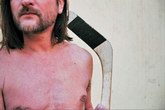
„A thousand lonely suicides“ ist Alejandro Vidals jüngste Werkreihe. Die -
in der Ausstellung gezeigten - Fotografien zeigen einen Ex-Sträfling; dieser
wollte sich nach einem Totschlagsversuch der Verhaftung durch Selbstmord
entziehen, durch Harakiri vor den Augen der Polizei. Vidal fasziniert dieses
Ritual des Harakiri, diese letzte Vorstellung vor einem ausgesuchten
Publikum. Das Publikum partizipiert am Ritual, ohne es wäre es kein
Harakiri, sondern die Aktion wäre nur ein „Sich-selbst-töten“.
 |
|
 |
|
 |
|
A thousand lonely suicides, 2005 |
||||
Hanauer Landstraße 134, 60314 Frankfurt, Germany, +49 (0)69-43053962
mail@galerieadler.com, www.galerieadler.com